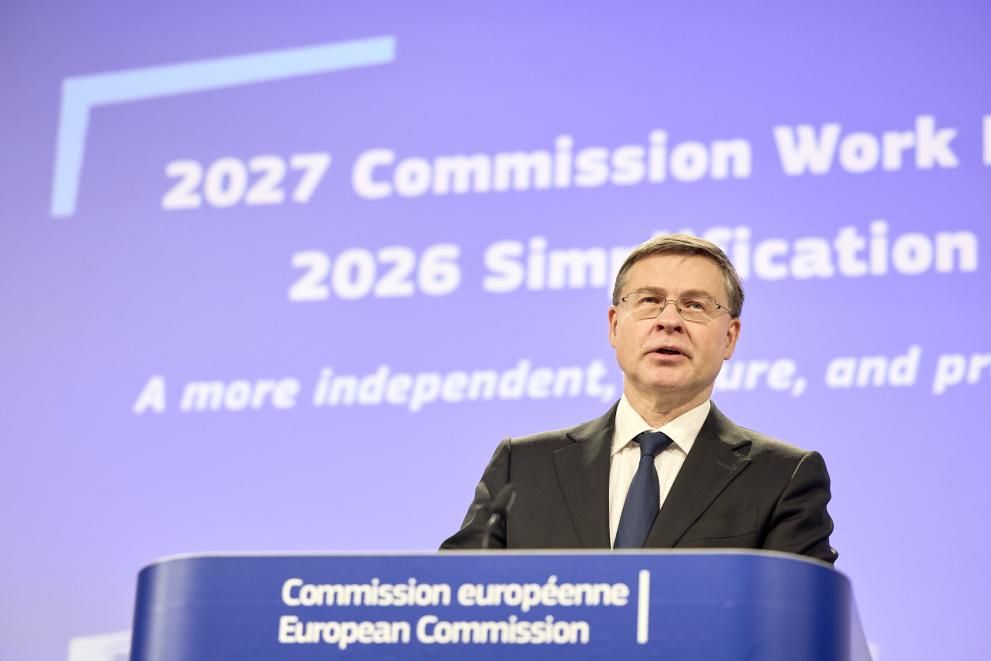
On 4 November 2026, the European Commission adopted its 2027 Work Programme, entitled “European Union – standing up for one another”. Presented by Executive Vice-President Valdis Dombrovskis and EU Commissioner Maroš Šefčovič, the programme sets out the Commission's legislative and policy priorities for the year ahead, with a strong focus on European competitiveness, simplification, investment and strategic autonomy.
The Commission highlights the need to accelerate the implementation of existing proposals while introducing new initiatives to address Europe's economic, social and environmental challenges. It estimates that its 12 Omnibus packages and other simplification measures could generate €22.3 billion in annual recurring administrative cost savings once fully implemented.
For the construction sector, the Work Programme contains a number of relevant initiatives and pending legislative proposals concerning the Single Market, permitting, digitalisation, energy, housing, skills, environmental legislation, public procurement and infrastructure investment.
The following overview provides the construction-related items that FIEC identified in the Commission's Work Programme and its annexes.
New initiatives: What to expect in 2027
- Single Market – Preventing market segmentation by suppliers (Q3 2027):
The Commission plans a legislative or non-legislative initiative to prevent market segmentation by suppliers, aiming to strengthen the functioning of the Single Market.
- Permitting acceleration (Q3 2027)
A legislative or non-legislative initiative is planned to accelerate permitting procedures, particularly for strategic projects. This is highly relevant to construction, as lengthy authorisation processes remain a significant obstacle to infrastructure investment and project delivery.
- Single Market barriers prevention (Q3 2027)
A further legislative or non-legislative initiative will address barriers within the Single Market, with the objective of preventing fragmentation and improving cross-border economic activity.
- Digital transformation package, simplification and copyright (Q2 2027)
A legislative package will address digital transformation, simplification and copyright, with implications for the development of the EU's digital regulatory framework.
- Post-2030 energy framework and simplification package (Q1 2027)
The Commission will present a legislative package establishing the post-2030 energy framework and simplifying existing rules. This will be particularly relevant to the construction sector in relation to energy efficiency, building renovation and the energy transition.
- Housing simplification package (Q2 2027)
A legislative simplification package will aim to increase housing supply by making it easier to build and renovate homes. The separate Affordable Housing Act, presented in September 2026, is also identified as a priority pending proposal.
- Skills Guarantee (Q3 2027)
This non-legislative initiative will support upskilling and reskilling towards growing and strategic sectors. It represents an opportunity to address persistent labour and skills shortages in construction.
- European Water Initiative (Q2 2027)
A legislative or non-legislative initiative will address water-related challenges and strengthen the resilience and sustainable management of Europe's water resources.
- European Heatwave Plan (Q2 2027)
This non-legislative initiative will strengthen Europe's preparedness for extreme heat. For construction, it is particularly relevant to workers' health and safety, the organisation of work on construction sites and the continuity of activities during periods of extreme temperatures.
- Review of nature protection Directives, including Birds, Habitats and Natura 2000 (Q3 2027)
The Commission plans a legislative or non-legislative review of the nature protection framework, including the Birds and Habitats Directives and Natura 2000. FIEC will follow this initiative closely, particularly in view of its potential implications for construction projects, environmental assessments and permitting procedures.
Priority pending proposals
In addition to the new initiatives, the Commission identifies several pending legislative proposals as priorities for rapid agreement by the European Parliament and Council. The following files are particularly relevant to FIEC, in the order in which they appear in Annex II.
- European Product Act (standardisation)
The proposal to revise the European Standardisation Regulation remains a priority. Developments will be important for the construction sector, given the role of European standards in the internal market and the construction products framework.
- Public Procurement Act
Presented in September 2026, the proposed Public Procurement Act would replace the three existing directives on public procurement and concessions with a single regulation. The Commission maintains this proposal as a priority, making it an important file for FIEC to follow closely.
- Emissions Trading System (ETS) Review
The Commission identifies the ETS review as a priority pending file. The proposals concern changes to the emissions trading framework, including monitoring, reporting and verification requirements and revisions to ETS benchmarks. Their implications for the construction industry's decarbonisation efforts will need to be monitored.
- Omnibus VIII on Environmental Legislation
The Commission calls for progress on this simplification package, which aims to reduce administrative burdens and streamline environmental requirements, including those affecting environmental assessments and permitting. FIEC will continue to advocate for genuine simplification without compromising the effectiveness of environmental protection.
- 2028–2034 Multiannual Financial Framework (MFF)
The Commission wants the co-legislators to reach an agreement on the next long-term EU budget by the end of 2026. Of particular relevance to construction is the proposed €81.4 billion Connecting Europe Facility (CEF) for 2028–2034, which would support investment in European transport and energy infrastructure.
Planned withdrawals
Finally, Annex III identifies pending legislative proposals that the Commission intends to withdraw within six months. Two are particularly relevant to FIEC.
- Green Claims Directive
The Commission intends to withdraw the proposal on the substantiation and communication of explicit environmental claims. The file has been pending with the co-legislators for more than three years. The Council failed to agree on a negotiating mandate in June 2024, and subsequent attempts to advance discussions in 2025 were unsuccessful.
- Late Payment Regulation
The Commission also intends to withdraw its 2023 proposal for a Regulation on combating late payment in commercial transactions. The file has been pending for more than three years, with a sizeable number of Member States opposing further work on the proposal.
The 2027 Work Programme confirms that simplification and competitiveness will remain central to the Commission's agenda. The Commission also announces a "Pact against Gold-Plating", intended to prevent Member States from adding unnecessary complexity when transposing or implementing EU rules.
The programme further reaffirms the EU's commitment to supporting Ukraine, notably by strengthening its critical infrastructure and revitalising the EU–Ukraine Solidarity Lanes.
2027 will also mark the tenth anniversary of the European Pillar of Social Rights, which the Commission intends to celebrate with a dedicated summit.
FIEC will closely monitor the initiatives and pending proposals outlined in the Work Programme, engaging with the European institutions to ensure that new measures genuinely simplify the regulatory environment, support investment and strengthen the competitiveness of the European construction industry, rather than creating additional administrative and regulatory burdens.
Click here to visit the European Commission website and download the 2027 Work Programme and its Annexes.