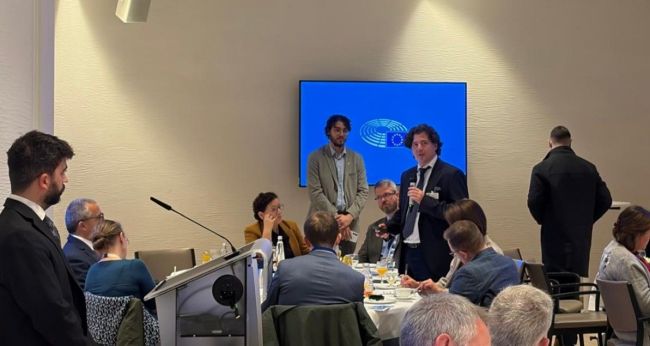
On 20 November, FIEC Vice-President Stephanos Pierides (CY) took part in a Parliamentary Breakfast, organised by Aggregates Europe and hosted by MEP Michalis Hadjipantela (EPP, Cyprus) at the European Parliament. The event looked at the importance of secondary materials for the circular economy, ahead of the forthcoming Circular Economy Act.
Construction and Demolition Waste (CDW) is the largest waste stream in the EU, putting the construction sector at the heart of the EU's circular objectives. The discussion was particularly timely for contractors, as EU End-of-Waste criteria for mineral CDW are being developed and will shape how easily secondary materials can be used on site. Participants called for a policy framework that encourages rather than hinders recycling and the use of secondary materials, while recognising that virgin materials are still needed.
Speakers also stressed that circularity and competitiveness must go hand in hand. Companies, particularly SMEs, need a coherent regulatory framework and a viable business case to invest in innovation.
FIEC called for a “secondary first” approach, under which locally available secondary materials are prioritised whenever technically, environmentally and economically suitable, instead of rigid recycled-content quotas. To make this work in practice, FIEC also called for the practical, "deemed-to-satisfy" inclusion of secondary materials in the applicable standards under the Construction Products Regulation, building on the End-of-Waste criteria for mineral CDW. In addition, public procurement should level the playing field, so that tenders do not favour primary materials by default, and use quality-based award criteria that encourage the use of secondary materials.
As the European Commission prepares the Circular Economy Act, FIEC remains committed to supporting a practical and coherent framework that enhances competitiveness, reduces reliance on virgin raw materials and enables the construction sector to contribute effectively to Europe's circular economy objectives.
In 2024 and together with European International Contractors (EIC) and ENCORD, FIEC released a publication to disseminate the vision on circularity in the construction ecosystem.
Click here to read or download the document.