
European Commission publishes proposal to review the European Standardisation Regulation
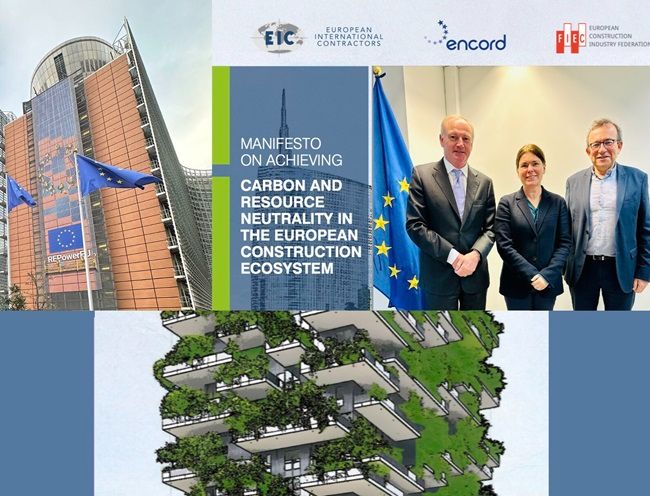
FIEC, EUROPEAN INTERNATIONAL CONSTRACTORS (EIC) and the European Network of Construction Companies for Research & Development (ENCORD) published their joint "Manifesto on Carbon and Resource Neutrality"
In this "Manifesto", the three above leading construction industry bodies in Europe have jointly published their solutions on a strategic shift towards a circular construction ecosystem. The document outlines a long-term vision and plan to reduce greenhouse gas emissions and increase resource efficiency. The Manifesto follows this year’s COP28 and aims to bring the European construction industry in line with global net-zero commitments.
With a foreword by Maroš Šefčovič, Executive Vice-President of the European Commission, the publication advocates a shift from the linear to a circular business model to drastically reduce waste production and raw material consumption. 90% of primary resources will need to be reused to achieve carbon and resource neutrality by 2050. This will require radical changes across the entire industry and unprecedented collaboration will be needed. The European construction industry considers overhauling and modernising the construction regulatory landscape vital to achieve carbon and resource neutrality across the European ecosystem.
To help all stakeholders and business prepare for the needed changes, the Manifesto highlights 6 strategic pillars, discussed by leading figures within the construction industry, to serve as a blueprint for change.
These are:
-
-
Resources – materials should be reviewed for re-use potential and processes with regard to efficient use of space, prefabrication and assembly should be redesigned.
-
Procurement – catalysing change by introducing innovative contracting models and collaborative working.
-
Financing – ensure financing works together with other stakeholders in managing risk and ensuring that it supports the Environmental, Social and Governance (ESG) objectives.
-
Energy – reducing energy use in construction and deploying Carbon Capture, Storage and Utilisation (CCSU) can radically change the embodied carbon in new infrastructure.
-
People – people need to be supported by a collaborative culture to foster high performance and innovation.
-
Data – digital data is key to developing connected information models, i.e. digital twins of real assets and is essential to enable all stakeholders to plan, design, build, operate and decommission collaboratively.
READ OR DOWNLOAD the Manifesto and the Press Release to get more details and discover the key messages of this one-in-a-kind joint work.
-

carbon_neutrality_manifesto.pdf
-
print_friendly_file_carbon_neutrality_manifesto.pdf
-
print_friendly_file_carbon_neutrality_manifesto.pdf
-
PRESS RELEASE_eic_fiec_encord_manifesto.pdf