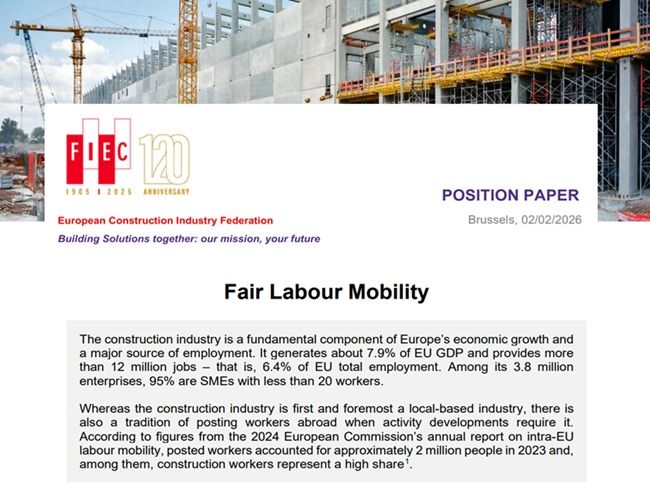
Responding to a Call for Evidence, on 2 February, FIEC sent to the European Commission its Position Paper on Fair Labour Mobility . In the document, FIEC insists that, except for very few very targeted pieces, no new legislation is required to make progress in this area.
In the first place, what is needed is better enforcement and simplification, to fight against unfair competition and illegal practices. This namely goes through the digitalisation of procedures and control tools. FIEC therefore encourages the roll-out of the European Social Security Pass (ESSPASS), the conclusion of the revision of the social security coordination rules and a cautious adoption and implementation of the e-declaration for posting workers. FIEC also points out the very important role played by national sectoral social ID cards – where they exist – to improve transparency.
Secondly, FIEC advocates for better information to be provided to employers, for them to navigate more easily in this complex legislative framework.
The European Labour Authority (ELA) has a clear role to play here, within its current mandate. FIEC indicates options to help tackle the shortage of (skilled) workers in construction, which includes the fair recruitment and integration of Third-Country Nationals (TCNs) in the EU construction market.
FInallyt, FIEC recalls that subcontracting in cross-border context is already covered by the Enforcement Directive and shall not be further regulated at the EU level. Transparency and control tools are better suited to make sure there are no abuses within a subcontracting chain.
The European Commission intends to present a Fair Labour Mobility package towards mid-2026.